


|
Testimonial
After trying the Voxformer demo I had to buy it. It has simplified my process for mixing vocals. Instead of using several plugs to get my vocal tracks right, I just use Voxformer because it lets me eq, compress, d-ess, boost presence, saturate, etc...I also like the fact that I can use Voxformer transparently or as an effect on my vocal mixes with excellent results. This plug is an incredible bargain, and as someone who owns quite a few expensive plugs I can say you'd be hard pressed to find a better value for your money anywhere. I'll definitely be purchasing more Voxengo plugs in the future.
Michael Lamoreaux
|
Voxengo Voxformer
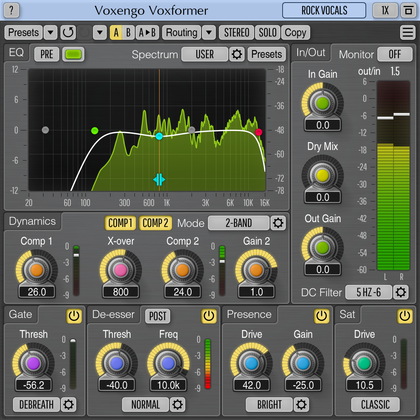
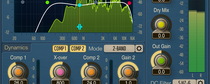
Voxformer is a multi-functional vocal channel strip plug-in. Combining several professional quality processing modules, Voxformer was designed to be a comprehensive solution for all your vocal processing needs - be it spoken or sung vocals.
The coolest feature of Voxformer is its one-knob vocal compressor. Using only a single knob, you can get a tight, open and definitive professional vocal sound in no time. You do not have to worry about common ratio, release, attack and make-up gain controls since they are automatically selected by the advanced compression algorithm. Moreover, Voxformer features two compressors of this type, allowing you to apply either a two-band or a two-stage (serial) vocal compression. For two-band compression Voxformer splits the audio signal into two spectral parts, by means of a switchable crossover filter.
Voxformer also features a de-esser with switchable center frequency and threshold. A noise gate is also available, which, in a manner similar to a compressor, was designed to bring ease of tuning while providing excellent sonic results. For those who like the saturated vocal sound, Voxformer implements a special saturation module which applies a smooth vintage saturation. Another useful thing Voxformer has to offer is the presence boosting module, which you can use to add some shine and space to the vocals.
To simplify the control over these processing modules, Voxformer implements residue listening, which allows you to hear what gets removed during de-essing and noise gate operation, and what is being added by the presence module.
As a finishing touch, Voxformer offers you a flexible 4-band equalizer (pre/post selectable) with a real-time output stage fast Fourier transform (FFT) spectrum analyzer display. Each equalizer band can be switched to a parametric, low-shelf, high-shelf, low-pass or high-pass filtering mode.
Features
- Two built-in vocal compressors
- Switchable crossover (2 types)
- Gain reduction meters
- 4-band equalizer
- Real-time FFT spectrum analyzer
- Asymmetric compression
- Vintage saturation module
- De-esser module (2 types)
- Presence boosting module
- Noise gate module
- High quality mode
- "A-to-B" comparisons
- Mono-to-Stereo, Stereo-to-Stereo processing
- Any sample rate is supported
- Factory presets
- 64-bit internal precision
- Native assembler DSP code
Requirements
- Windows XP or any later 32-bit Windows OS
- About 1 MB of harddisk space
- 1+ GHz processor
- Audio application supporting VST plug-ins
Demo Limitations
Processing stops for a moment every 25 seconds.
Examples
Here you can listen to several working results of Voxformer. These examples were produced by Vitaly Zolotarev @ Dawn Raid Studio, New Zealand.
What's New
Version 1.9, 16-mar-2008
Minor fixes.
Version 1.8, 08-aug-2007
- Extreme level pop fixed that could appear with the enhancer module enabled.
- Access violation error on systems with >2GB memory solved.
Version 1.7, 12-nov-2005
- Fixed keyboard 'stealing' when plug-in is used in Cubase SX 3.1.
- Fixed "Auto" quality mode operation bug.
- EQ display cursor position readout inaccuracy fixed.
Version 1.6, 02-aug-2005
Presence module center frequency range extended down to 100 Hz. This allows to apply 'presence' technique in the lower frequency range. This usually allows to boost overall body of the voice - especially if it sounds weak. Check out the "More Body To Voice" preset for the demonstration.
Version 1.5, 01-apr-2005
A new crossover filter type 2 introduced.
Version 1.4, 29-nov-2004
- De-esser's filtering bug fixed.
- De-esser's gain reduction meter range increased up to 10 dB.
- Output clipping indicator added. It will turn red when three sequential clip incidents were detected on any of the output channels.
Version 1.3, 04-oct-2004
- RMS difference counter implemented. This counter shows the difference between the input and output RMS power. Click to reset.
- "Auto" quality mode added. The Auto mode selects the Normal mode during real-time processing; during offline/bounce processing the High quality mode is used.
- Minor performance optimizations.
- A new deesser algorithm "2" implemented which can be selected on the UI screen.
Version 1.2, 25-jun-2004
- Fixed crash in Sonar 2.2 and VST Adapter (when switching presets).
- Fixed occasional hangups when shrinking down plug-in's window in WaveLab.
Version 1.1, 21-jun-2004
- Listen "Comp A" and "Comp B" options added.
- Comp B (when used in serial mode) was applied before Comp A. This was fixed: Comp B will work after Comp A now.
- "In" gain control added. Using this control you can adjust any existing preset to suit the new program material you wish to apply this preset to.
- Presence module type switch added. Now presence can be switched from the default "post" mode to the "pre" mode where it uses signal before it is fed into compressor, but mixes the output, like in the "post" mode, after compression takes place.
- Gate meter added. It only shows the moments when gate is opening, this meter has no specific scale.
- A rearrangement of controls introduced. Also, frequency scale labels under the equalizer screen were added.
- Asymmetric compression mode implemented.
- Minor speed-ups.
- "Misc" control panel added. This panel features several additional module controls. De-esser's ratio control has been moved to this panel also. Beside this you can also adjust the bandwidth (inverse Q) of de-esser's side-chain filter, presence module's filter and you can also define saturator module's bias which gives you control over the harmonic content.
- De-esser's gain reduction meter scale changed from 10 dB to 3 dB.
- Steepness of de-esser's filter increased. This may require some minor fune-tuning of the existing presets.
Version 1.0, 28-apr-2004
Initial release.
Version 1.0a, 14-apr-2004
Beta release.