


|
This topic was last updated 180 days ago, and thus it can be considered old. Replying is disabled for this topic.
|
alexisone
on Aug 5, 2011, 2:01pm, edited 1 time(s), last modified on Aug 5, 2011, 2:03pm:
Hi!
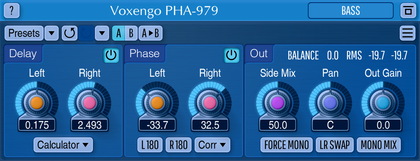
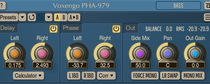
First time poster here (and very newbie-like). I just downloaded the trial PHA-979. I was thinking the full version might be the thing to use for 2 mics simultaneously recording a vocal track ... does that sound like a good use?
I've read the manual for the Correlometer, and I'm not really sure how to use it, including interpreting the display (not limited to asking: "'X'-axis ... milliseconds of ... what?"). As I couldn't find any youtubes for the PHA-979, could someone please give as much a step-by-step as they can tolerate for that please? Or, if I'm missing seeing the youtubes, please point me in the right direction **embarrassed smiley here** .
Thanks in advance!
Alexis
First time poster here (and very newbie-like). I just downloaded the trial PHA-979. I was thinking the full version might be the thing to use for 2 mics simultaneously recording a vocal track ... does that sound like a good use?
I've read the manual for the Correlometer, and I'm not really sure how to use it, including interpreting the display (not limited to asking: "'X'-axis ... milliseconds of ... what?"). As I couldn't find any youtubes for the PHA-979, could someone please give as much a step-by-step as they can tolerate for that please? Or, if I'm missing seeing the youtubes, please point me in the right direction **embarrassed smiley here** .
Thanks in advance!
Alexis
Aleksey Vaneev
on Aug 6, 2011, 8:45am:
Yes, PHA-979 is fine to use to adjust double-mic vocal recordings.
Correlometer displays per-frequency correlation of two sound sources.
Correlation is a bit advanced topic - I suggest you to generally study it better first.
Correlometer displays per-frequency correlation of two sound sources.
Correlation is a bit advanced topic - I suggest you to generally study it better first.
alexisone
on Aug 10, 2011, 1:43pm, edited 1 time(s), last modified on Aug 10, 2011, 1:50pm:
OK, I've done some reading, with some better understanding.
It would be great to see some videos of this in action, that would clarify some things.
For example, I could imagine where phase shifting by differing amounts would result in various correlation graphs, none of which are clearly "perfect".
How does one pick the best phase shift under those circumstances? Choose the graph with the averaged "area under the curve" closest to 1.0? Choose the phase shift resulting in the graph where the most "important" frequencies are best correlated?
I suppose the classic answer might be, "Whatever sounds best", but then one could ask what's the point of the graph in the 1st place then?
Thanks - obviously a newb ... any insight will be helpful!
It would be great to see some videos of this in action, that would clarify some things.
For example, I could imagine where phase shifting by differing amounts would result in various correlation graphs, none of which are clearly "perfect".
How does one pick the best phase shift under those circumstances? Choose the graph with the averaged "area under the curve" closest to 1.0? Choose the phase shift resulting in the graph where the most "important" frequencies are best correlated?
I suppose the classic answer might be, "Whatever sounds best", but then one could ask what's the point of the graph in the 1st place then?
Thanks - obviously a newb ... any insight will be helpful!
Aleksey Vaneev
on Aug 10, 2011, 2:22pm:
Usually, you should strive to get 1.0 correlation of the most loud frequency regions shared between two mics. On the other hand, you do not usually need to get 1.0 correlation in the higher frequency range. So, in most cases you just need to correlate frequencies below 1 kHz - what is above is either can't be correlated well, or does not need to be correlated at all.
But this is my experience - somebody else may give you another idea. Correlation being a technical measurement cannot be always used in a straight-forward way when producing music.
alexisone
on Aug 10, 2011, 2:28pm:
Great, thank you, Aleksey!
Aleksey Vaneev
on Aug 10, 2011, 2:36pm:
You are welcome!
|
This topic was last updated 180 days ago, and thus it can be considered old. Replying is disabled for this topic.
|
Copyright © 2002-2012 Aleksey Vaneev - Terms of Use - Privacy Policy - About Voxengo - Questions & Answers